
Instruments that support cutting-edge methodologies are often too expensive for the average principal investigator to purchase and maintain. These instruments also require operators with specialized training and knowledge and offer experimental capacity beyond the needs of a single lab.
Institutional shared research facilities make these specialized technologies available and enable groundbreaking discoveries by sharing ownership and operation costs and by employing instrument specialists to minimize costly operator errors.
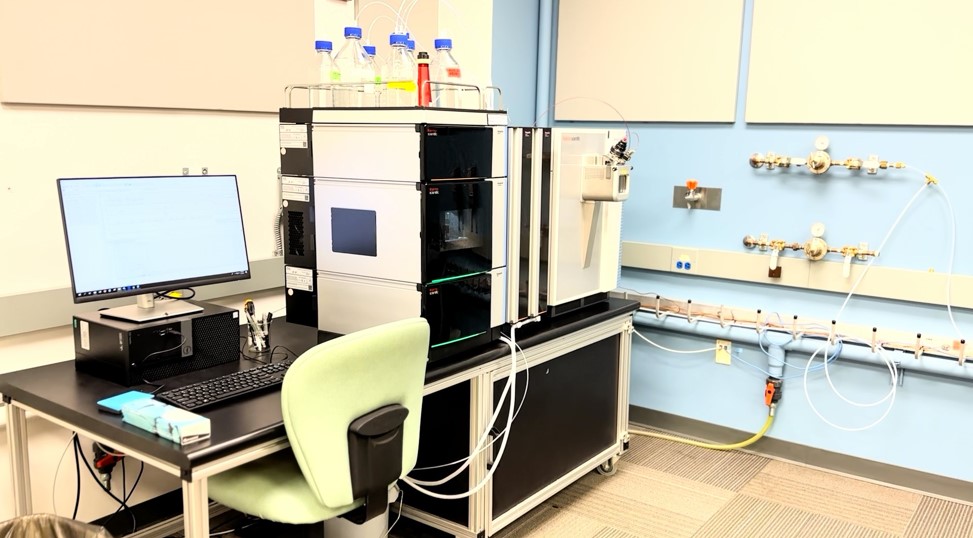
Mass spectrometry instrumentation is a prime example of specialized equipment offering wide research applications. This Research Resource Nexus edition and the next will introduce two of the mass spectrometry cores at Pitt. This month, we are focusing on the Health Sciences Mass Spectrometry Core.
The Health Sciences Mass Spectrometry Core (MSC)
Watch the Health Sciences Mass Spectrometry Core introductory video.
MSC provides analysis of proteins, small molecules and lipids from any biological source. The knowledge base and high-end instrumentation at the MSC are ideal for
- discovery-based, hypothesis-free analysis of global changes in metabolites, lipid composition and protein expression
- targeted profiling of chemical classes or metabolic pathways
MSC also supports low-level quantitative measurements of multiple targets in complex samples using either mass spectrometry or Olink targeted proximity extension assay (PEA) technology, which is ideal for targeting low-abundance proteins in plasma and serum.
“The dynamic range of the proteome and metabolome is huge,” says MSC Assistant Director Steve Mullet. MSC’s skill and expertise can provide meaningful data within a significant portion of that range.
Consultation and Project Planning with MSC
Schedule a consultation with the MSC.
All projects at MSC begin with an initial consultation between the investigator and MSC leadership to discuss scientific aims and study design. Together, a project plan is developed to address everything from experimental design through publication or grant submission, including
- sample collection and preparation,
- liquid chromatography-high resolution mass spectrometry (LC-HRMS) analysis,
- data analysis, and
- figure generation.
Testimonials:
Mass spectrometry is a collaborative process requiring input from the investigator and MSC faculty and staff, even at the laboratory service model level. As projects expand and require substantial scientific input from key personnel, MSC offers the opportunity to establish more formal collaborations.
Pitt investigators have applied the multidimensional analysis supported by MSC in many disciplines.
- Gwendolyn Sowa (Department of Physical Medicine and Rehabilitation) is leading a project using broad “omics” to phenotype low back pain to identify sub-groups that respond differently to varying treatment options. Stacy Gelhaus, MSC scientific director, has provided expert guidance on combining discovery and targeted analytical techniques to keep the study broad and unbiased while generating specific findings. “MSC has been outstanding to work with scientifically and logistically—they are great partners,” says Sowa.
- Robert Sweet (Department of Psychiatry) investigates the biological mechanisms of psychosis in Alzheimer’s disease (AD) and potential treatments. A recent study from his lab utilized mass spectrometric analysis of the synaptic proteome in conjunction with behavioral testing to investigate the effect of fingolimod, an FDA-approved drug for multiple sclerosis, on a murine model of AD with psychosis.¹
- Mark Shlomchik (Department of Immunology) and his team refuted the paradigm that germinal center B cells (GCBCs) primarily relied on glycolysis for proliferation and function using ¹³C stable isotope tracing and high-resolution mass spectrometry. In this study, they used universally labeled ¹³C-glucose and universally labeled ¹³C-palmitate to demonstrate that GCBCs preferred fatty acids as their energy substrate, as shown by the increase in ¹³C-labeled carbons in acetyl-CoA from ¹³C palmitate.²
References
1. Krivinko JM, Erickson SL, MacDonald ML, Garver ME, Sweet RA. Fingolimod mitigates synaptic deficits and psychosis-like behavior in APP/PSEN1 mice. Alzheimers Dement (N Y). 2022 Aug 22;8(1):e12324. doi: 10.1002/trc2.12324. PMID: 36016832; PMCID: PMC9395154.
2. Weisel FJ, Mullett SJ, Elsner RF, Menk AV, Luo W, Wilkenheiser D, Hawse WF, Chikina M, Smita S, Conter LJ, Joachim SM, Wendell SL, Winkler TH, Delgoffe GM, Shlomchik MJ. Germinal center B cells utilize only minimal glycolysis but selectively oxidize fatty acids for energy. Nature Immunology. 21:331-342, 2020. PMID: 32066950.