
Last month’s Research Resource Nexus edition provided information on Pitt’s mass spectrometry resources for the global analysis of proteins, lipids and small molecules. This month, we introduce the Small Molecule Biomarker Core, which provides expert mass spectrometry support for specific and targeted biomarker applications.
Small Molecule Biomarker Core
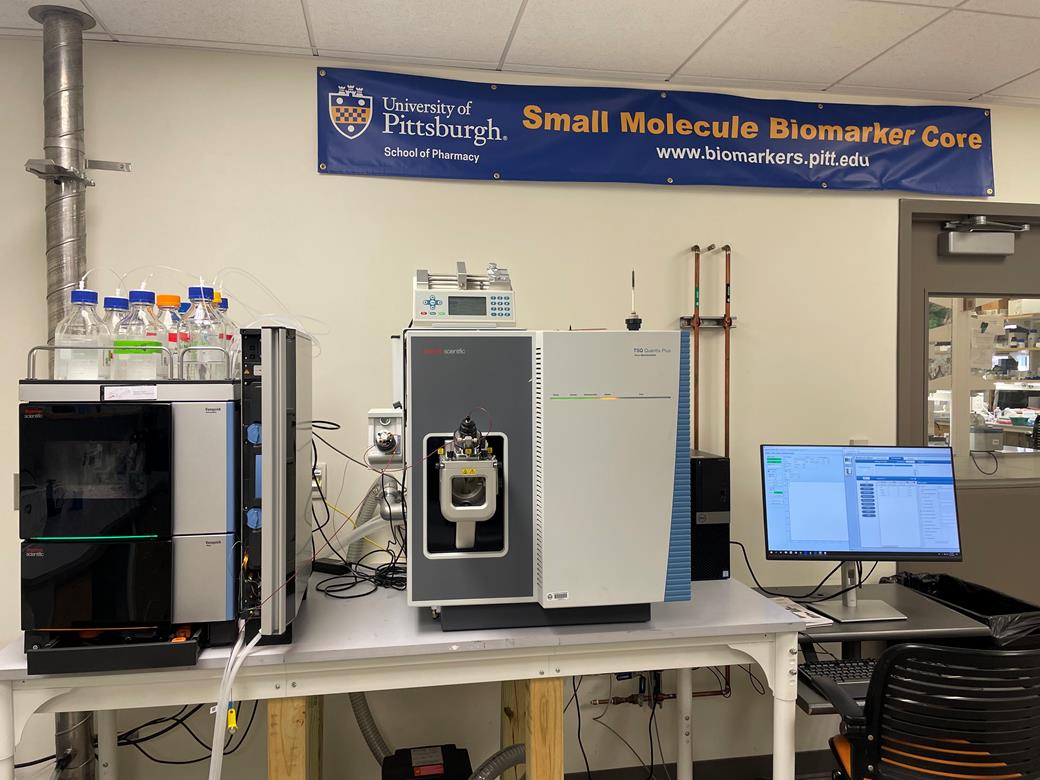
The Small Molecule Biomarker Core (SMBC) offers precise quantitative analysis of targeted molecular biomarkers using ultra performance liquid chromatography tandem mass spectrometry (UPLC-MS/MS). UPLC-MS/MS can accurately measure multiple targets simultaneously from a single aliquot of any biofluid or homogenized tissue down to one picomolar. Common applications include measuring drugs, drug metabolites and endogenous nonprotein compounds.
More than twenty validated assay panels are available through SMBC, including
- estrogens, progestins and prostaglandins,
- antiretroviral drugs, and
- tetrahydrocannabinol and its metabolites.
Custom assay development is also available.
With prior arrangement, reports detailing SMBC assay development and comprehensive validation, following U.S. Food and Drug Administration guidelines for bioanalytical method validation, can be collected to ease transitions to clinical use.
Testimonials
Expert staff at SMBC provide personalized project management whether the study requires complex assay development or routine implementation of standard assays.
“SMBC values communication and reliability—they will work with you closely to discuss capabilities, logistics, costs and timelines,” says Aaron Devanathan, assistant professor of pharmacy and therapeutics, School of Pharmacy. “If there are any issues that arise, they communicate those to you to reach an appropriate resolution. They follow up and follow through—keeping you abreast of progress.”
- Devanathan relies heavily on the expertise of SMBC personnel for his research in pharmacokinetics and pharmacodynamics of antiretroviral drugs to treat and prevent HIV. In addition to established assays for small molecule markers of inflammation, Devanathan and SMBC have collaborated closely to develop methods to measure the antiretroviral drugs of interest in critical tissues of HIV infection, including plasma, gastrointestinal and reproductive tracts. Devanathan credits his access to SMBC with accelerating the trajectory of his research career. “If I had to purchase the equipment and develop the expertise myself, it would have taken several years to get to this point [where novel assay development is well underway],” he says.
- Robert Friedlander, Dr. Walter E. Dandy Professor of Neurological Surgery, School of Medicine, and his lab published a paper reporting the effect of reduced melatonin in aging. Using SMBC to assay melatonin in murine pineal glands, mitochondria and cultured cells, their results demonstrated that increased melatonin mitigates the inflammatory response associated with neurodegeneration and aging activated by cytosolic mtDNA.¹
- Edwin Jackson, Distinguished Professor of Pharmacology and Chemical Biology, School of Medicine, used SMBC services to examine inosine, guanosine and adenosine levels in the urine of COVID-19 patients suffering from acute kidney injury (AKI). Results showed significantly reduced levels of these purines but unaltered levels of their precursors between COVID-19 patients who did and did not have AKI. These findings point to potential therapeutic avenues that may lead to effective interventions reducing AKI risk in hospitalized COVID-19 patients.²
References
1. Jauhari A, Baranov SV, Suofu Y, Kim J, Singh T, Yablonska S, Li F, Wang X, Oberly P, Minnigh MB, Poloyac SM, Carlisle DL, Friedlander RM. Melatonin inhibits cytosolic mitochondrial DNA-induced neuroinflammatory signaling in accelerated aging and neurodegeneration. J Clin Invest. 2020 Jun 1;130(6):3124-3136. doi: 10.1172/JCI135026. Erratum in: J Clin Invest. 2021 May 3;131(9): PMID: 32182222; PMCID: PMC7260019.
2. Jackson EK, Kitsios GD, Lu MY, Schaefer CM, Kessinger CJ, McVerry BJ, Morris A, Macatangay BJC. Suppressed renoprotective purines in COVID-19 patients with acute kidney injury. Sci Rep. 2022 Oct 17;12(1):17353. doi: 10.1038/s41598-022-22349-z. PMID: 36253495; PMCID: PMC9574168.