
Each shared research resource focuses on a particular technology, application or instrument type, which enables personnel to develop expert knowledge within that specialty. This expertise is available to Pitt investigators—freeing them from spending time and resources developing a knowledge base peripheral to their research focus.
The Pitt Biospecimen Core (PBC) offers specialized knowledge in biospecimen handling and banking, collection of clinical samples within UPMC hospitals, and regulatory compliance and is this month’s featured resource.

Watch the Pitt Biospecimen Core’s video introduction.
Overview of PBC Services:
PBC provides critical support for clinical research by providing access to de-identified specimens from patients seen at UPMC hospitals. Supporting both prospective and retrospective studies, PBC services include
- collection of any type of biospecimen following project-specific standard operating procedures (SOPs);
- sample processing (including flash freezing, formalin fixation or preparation of viable cells);
- research histology services;
- cryopreservation of viable cells;
- secure specimen banking with exclusive primary investigator (PI)-directed access;
- robust specimen annotation and record maintenance;
- full-service IRB-approved honest broker services; and
- access to an extensive historical biorepository of surgical tissue excess and biofluids dating back more than 40 years.
Expert Support for Investigators:
Expert PBC staff work with investigators to
- review regulatory compliance,
- determine inclusion criteria,
- identify cases, and
- develop custom SOPs for specimen collection and processing.
Quality Assurance Measures:
PBC has a rigorous quality assurance program in place to review SOP compliance—an important safeguard to control pre-analytic variables.
Available Specimens:
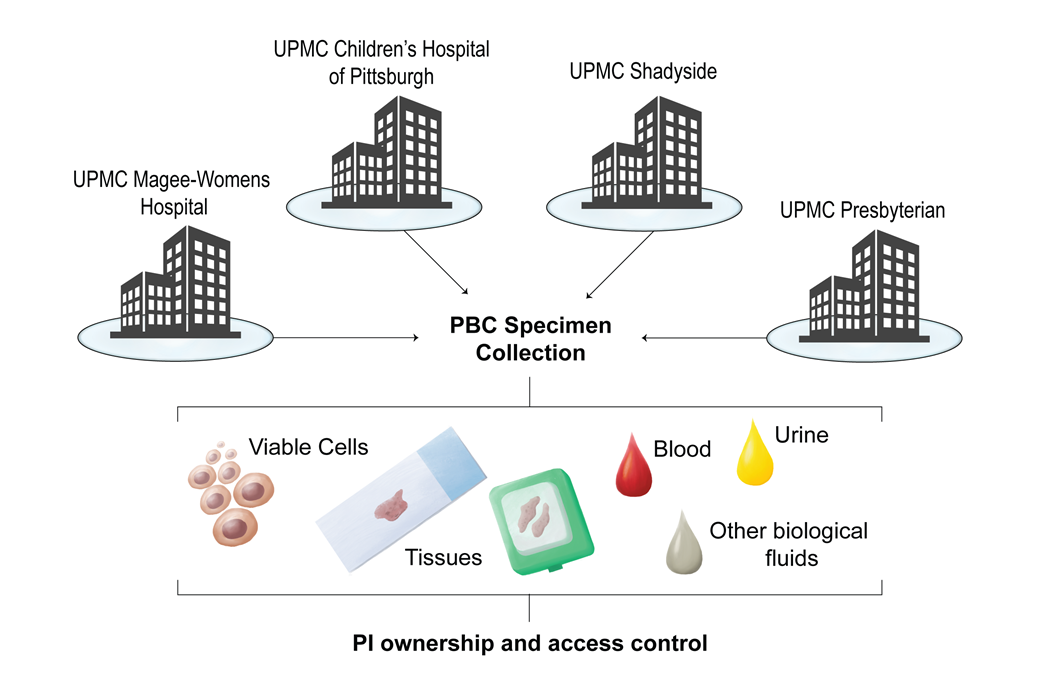
PBC’s historical biorepository holds more than 800,000 specimens collected from more than 80,000 patients at sites in UPMC Shadyside, UPMC Presbyterian and UPMC Magee-Womens Hospital, dating back to 1981. Specimens include many types of frozen (-80°C) tissue, urine, saliva, sputum and blood products.
PIs retain ownership and control of access for all specimens collected for their funded studies.
Initiating Services:
PBC services can be initiated via the PBC project management request tool. A PBC project manager is assigned to each request to provide the organization's hallmark personalized assistance.
Collection Services:
Collection services are available from 7:30 a.m. to 4 p.m. at UPMC Shadyside, UPMC Presbyterian, UPMC Magee-Womens Hospital and UPMC Children’s Hospital of Pittsburgh.
Testimonials:
Using PBC to support specimen collection and storage is seamless and more robust than adding the administrative burden of annotation and inventory tracking to the workload of individual labs.
- Francesmary Modugno (Department of Obstetrics, Gynecology and Reproductive Sciences) uses PBC services frequently, including in a 2022 consortium study identifying two distinct clusters of methylation patterns in ovarian clear cell carcinoma (OCCC), which has opened new avenues of exploration in the search for effective OCCC treatment (Fortner et al. 2020).
- PBC processes, stores and disperses samples for the Gynecologic Oncology Biospecimen and Data Bank. The bank is a repository of specimens from healthy women and those with gynecological malignancies, to support basic, translational, and population science.
- Adrian V. Lee and Steffi Oesterreich (Department of Pharmacology and Chemical Biology) use PBC for sample collection, processing and banking of their unique repository of liquid biopsies from each stage of breast cancer progression. With up to 10-11 time points collected from patients, their plan to study ctDNA and biomarkers from this biorepository will provide an unparalleled view of the disease.
References
Fortner RT, Rice MS, Knutsen SF, Orlich MJ, Visvanathan K, Patel AV, Gaudet MM, Tjønneland A, Kvaskoff M, Kaaks R, Trichopolou A, Pala V, Onland-Moret NC, Gram IT, Amiano P, Idahl A, Allen NE, Weiderpass E, Poynter JN, Robien K, Giles GG, Milne RL, Setiawan VW, Merritt MA, van den Brandt PA, Zeleniuch-Jacquotte A, Arslan AA, O'Brien KM, Sandler DP, Wolk A, Håkansson N, Harris HR, Trabert B, Wentzensen N, Tworoger SS, Schouten LJ. Ovarian Cancer Risk Factor Associations by Primary Anatomic Site: The Ovarian Cancer Cohort Consortium. Cancer Epidemiol Biomarkers Prev. 2020 Oct;29(10):2010-2018. doi: 10.1158/1055-9965.EPI-20-0354. Epub 2020 Jul 30. PMID: 32732252; PMCID: PMC7541500.