
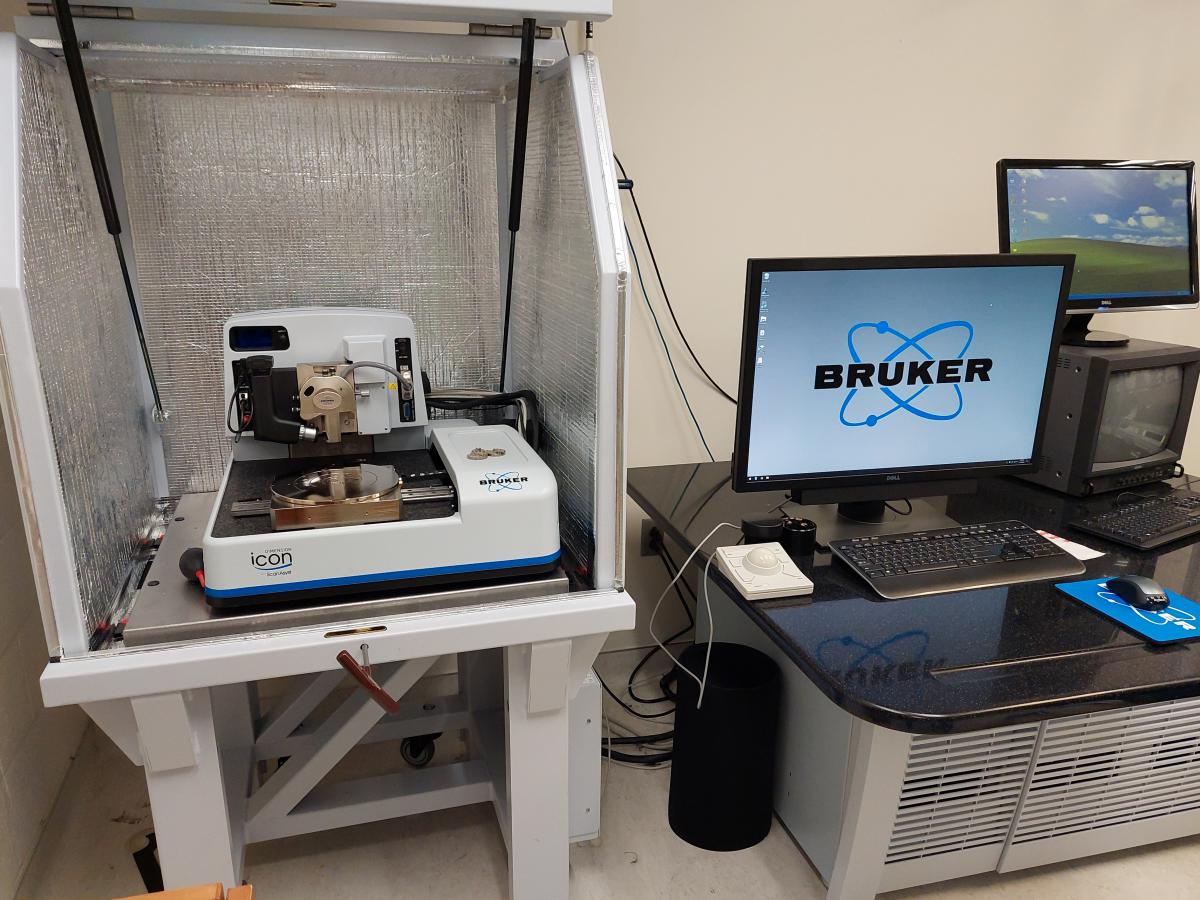
 The Bruker Dimension Icon Atomic Force microscopy [AFM] is a high-performance tip-scanning AFM platform. This system can accommodate samples with diameters ≤ 210mm and thicknesses ≤ 15 mm, has an X-Y scan range approaching 90 µm and a Z range approaching 10 µm. It is versatile, system capable of performing an array of scanning probe-based techniques, in air or liquid. ScanAsyst automated parameter optimization and preconfigured experimental profiles streamlines operation and helps facilitate reliable and repeatable measurements.
- This AFM is controlled by a NanoScope VI controller, released 2021, which has enhanced high-speed data capture capabilities and can simultaneously display and capture up eight high pixel density images (up to 5120 x 5120 pixels).
Key Features
- Large area scanner, with low noise XYZ closed loop scan head
- Mechanical Property Mapping
- Includes PeakForce Quantitative Nanoscale Mechanical [QNM] characterization, which is capable of operating over a wide range. 1MPa to 50 GPA for modulus and 10pN to 10 uN for adhesion. PeakForce QNM | Bruker
- Electrical Characterization
- PeakForce TUNA: High resolution current mapping and correlated quantitative nanomechanical property imaging, suitable for a wide range of samples and capable of operating current sensing in the fA to µA ranges. PeakForce TUNA | Bruker
Key Applications and available processes
- Standard AFM modes: ScanAsyst, PeakForce Tapping, TappingMode, Contact Mode, Lateral Force Microscopy, PhaseImaging, Lift Mode, MFM, Surface Potential, EFM, Force Spectroscopy, Force Volume, Piezoresponse Microscopy
- Advanced optional AFM modes:
- PeakForce QNM
- PeakForce TUNA
- Force Modulation, Torisional Resonance Mode, liquid mode imaging
Check Availability
Already have an account?
Reserve this tool with the FOM.
Equipment Fee
Characterization Service 1
Core Facility
Gertrude E. and John M. Petersen Institute of NanoScience and Engineering
Location
Lower Campus
Equipment Type
Materials Characterization Techniques