
The Packard 2000TR liquid scintillation counter (LSC) is used to quantify low-energy radioisotopes, especially alpha and beta emitters. The sample is dissolved in a fluor cocktail, a solvent containing organic molecules that pick up and absorb the emitted energy from the radioactive decay of a nucleus and convert it to a photon of light. This photons are then detected with a pair of photomultiplier tubes operating in coincidence. Strong beta emitters may be detected without the use of fluors via Cherenkov counting. In the later technique, the radioactive decay releases energetic radiation into the solvent where the emitted beta particle is traveling faster than the speed of light in that solvent. This produces a pale blue emission (Cherenkov radiation) that can be quantified using a single photomultiplier tube.
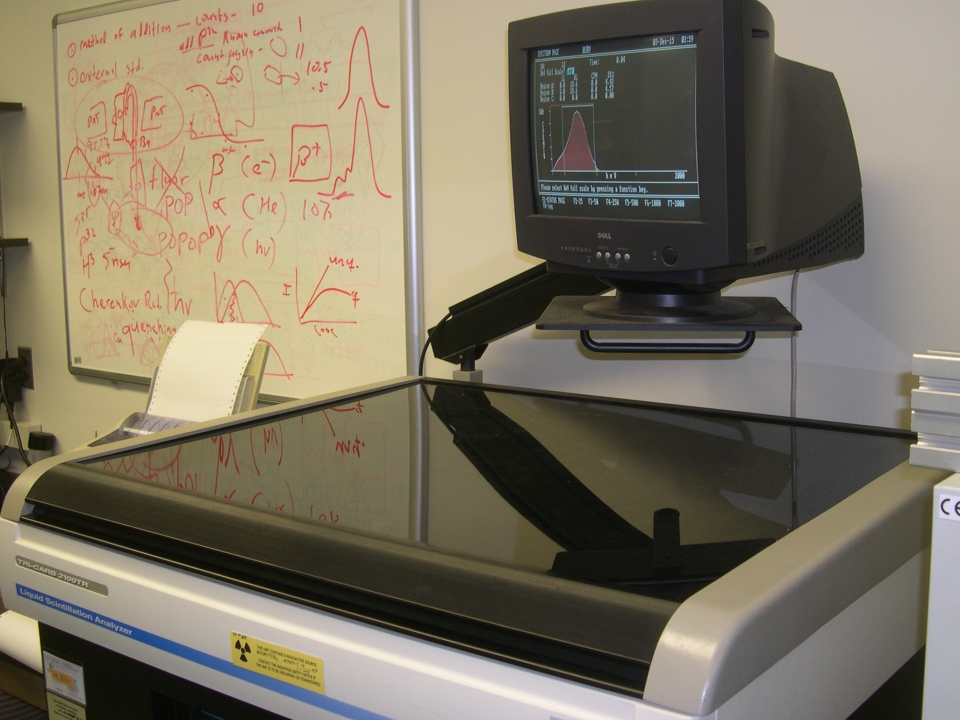
The 2000TR can measure emission in the energy range of 0-2000 keV and can operate in both a normal counting and high sensitivity counting mode. An internal 133Ba standard allows the correction of quenching effects for absorbing samples. Low volume sample holders are available